
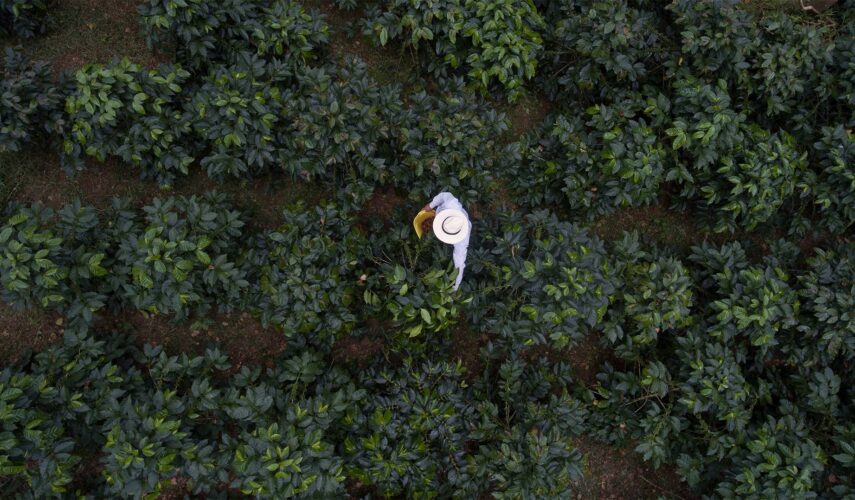
Most Colombian coffee grows in the Andes. The Sierra Nevada de Santa Marta is different. It is a separate mountain range in the far north of the country, standing on its own beside the Caribbean Sea. From the beaches near Santa Marta, the land climbs to peaks that hold snow all year.
A mountain with its own climate
Because the range rises so quickly from the coast, it packs many climates into a small area: hot lowlands, cloud forest, cool upper slopes and high moorland. Coffee grows in the middle band, where farms usually sit between about 1,200 and 1,800 metres. Warm days, sea air and a long dry season all shape how the beans develop.
Grown in the shade
Many farms in the Sierra Nevada grow coffee under a canopy of taller trees. The shade protects the plants from the strong northern sun, keeps the soil cool and moist, and gives birds and insects a place to live. Under that cover, the cherries ripen at an even pace.
The Sierra is also home to four Indigenous peoples, the Arhuaco, Kogui, Wiwa and Kankuamo, who hold the mountain sacred. Many of their families grow coffee alongside the food they eat, and several community cooperatives now sell their coffee around the world.
What you taste
Our Sierra Nevada coffee is the strongest of our single origins, with low acidity and a full body. Expect dark chocolate, sweet caramel and roasted walnut. It is round and deep, with very little sharpness.
How to brew it
This is a coffee for full-bodied methods. A French press, a moka pot or an espresso machine will bring out its chocolate and nut notes, and it holds up well with milk. For a French press, use a coarse grind and about 1 gram of coffee to 15 grams of water, and steep for four minutes.
Short on time? Sierra Nevada also comes as drip sachets that brew straight into your cup.
For step-by-step recipes, see our brewing guide.
 English
 العربية
 Español
